



Step-by-Step Party Planning in Estonia: Complete Guide 2026
Party planning often turns into chaos: endless task lists, dozens of calls to contractors, unexpected expenses, and constant stress. Without clear structure, it’s easy to miss important details or overpay for services. A structured workflow helps organize the process efficiently, control budget, and avoid common mistakes. In this article, you’ll get a step-by-step guide to event planning in Estonia: from venue selection to results evaluation. You’ll learn to choose services, manage contractors, and create unforgettable events with minimal effort.
Key Takeaways for Party Planning Workflow
| Point | Details |
|---|---|
| Structured Approach | Workflow includes preparation, venue selection, service booking, and execution control to reduce risks |
| Venue Selection | Location, capacity, and transport accessibility affect budget and guest convenience |
| Process Automation | Digital tools speed up data collection and help save up to 30% of time |
| Service Flexibility | Ability to adapt space and rental conditions improves event quality |
| Results Verification | Collecting feedback and analyzing metrics helps improve future events |
What You Need for Party Planning: Preparation and Requirements
Before starting organization, you need to gather basic information and determine key event parameters. Create a guest list considering age groups and preferences — this helps choose party format and calculate budget. Set the date with time buffer, considering seasonality and venue costs, as weekend rental prices are typically 20-40% higher.
Venue selection requires analyzing several criteria. Proximity to public transport and parking availability are critically important for guest comfort. Capacity should match the number of invitees with 10-15% buffer for free movement. Check technical equipment: sound, lighting, projector, kitchen facilities.
A detailed service list simplifies coordination. Main categories:
- Catering: menu, dish quantities, dietary restrictions
- Music: DJ, live band, sound equipment
- Photo and video: service packages, shooting duration, material processing
- Decor: thematic decoration, flowers, lighting
- Furniture and tableware rental: tables, chairs, textiles, serving
Automating information collection significantly speeds up the process. Use online spreadsheets to compare contractor offers, digital checklists for task control, and messengers for quick communication. This saves up to 15 hours of work time during preparation.
Professional tip: Create a unified document with all contractor contacts, payment deadlines, and key agreements. This prevents confusion and helps quickly resolve issues during preparation.
Budget planning starts with allocating funds by categories. Typical expense structure:
| Category | Budget Share | Approximate Amount (for 50 guests) |
|---|---|---|
| Venue rental | 25-30% | 500-800 EUR |
| Catering | 35-40% | 700-1200 EUR |
| Entertainment and music | 15-20% | 300-500 EUR |
| Decor and decoration | 10-15% | 200-400 EUR |
| Photo and video | 10-15% | 200-400 EUR |
Set aside 10-15% of total budget for unexpected expenses. Early booking allows getting discounts up to 20%.
Step-by-Step Party Organization Workflow in Estonia
Implementing prepared plans requires sequential actions and clear coordination. Follow this proven algorithm:
- Book venue 2-3 months before the event, clarify rental conditions, preparation and cleanup access time, basic equipment availability
- Identify contractors for key services, request portfolios and reviews, conduct meetings to discuss details
- Agree on menu with catering, considering guest dietary preferences, product seasonality, and serving format
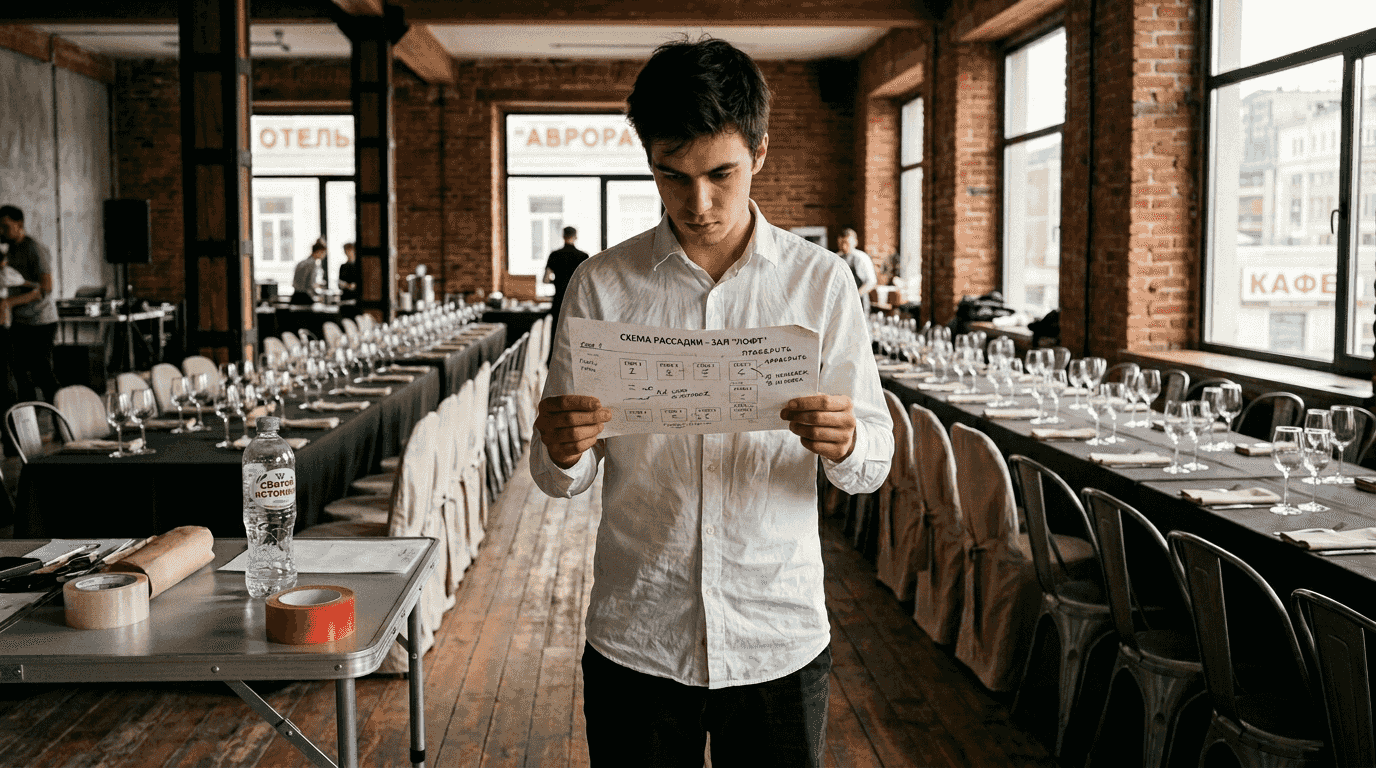
- Create furniture arrangement and space zoning plan: reception area, dance floor, photo zone, gift area
- Develop event script with timing plan: welcome, entertainment program, toasts, dancing
- Organize final meeting with contractors one week before event to synchronize actions
Venue choice determines event atmosphere and functionality. Space flexibility and ability to bring own alcohol without extra charge are important advantages for organizers. Compare conditions of different locations:
| Criteria | Restaurant with Hall | Separate Venue | Open Space |
|---|---|---|---|
| Catering | Included in rental | Free choice | Requires organization |
| Decor flexibility | Limited | Complete freedom | Weather dependent |
| Rental cost | 400-1000 EUR | 300-800 EUR | 200-600 EUR |
| Technical equipment | Basic included | Often requires rental | Minimal |
Contractor coordination requires a systematic approach. Create a group chat for quick communication, assign a responsible coordinator for event day, prepare backup contacts for emergencies. Use digital tools to track task status: who, what, and by when should be completed.
Professional tip: 48 hours before the event, conduct final verification of all agreements. Call each contractor, confirm arrival time, clarify details, and ensure everyone understands their tasks identically.
Venue contract details often contain hidden conditions. Pay attention to music time restrictions, cleaning rules, security deposits, damage penalties. Request written confirmation of all verbal agreements.
Transport logistics affects guest impressions. If venue is outside the city, organize transfer or clearly describe route with map. For central locations, indicate nearest public transport stops and parking. Check out venue listings for convenient locations.
Common Mistakes and How to Avoid Them in Party Planning
Even experienced organizers face problems that can be prevented in advance. Late venue booking limits choices and increases costs by 30-50% in high season. Start searching at least 8-12 weeks before event date. Not considering transport accessibility leads to guest delays and negative reviews.
Incomplete communication with contractors creates misunderstanding risks. Document all agreements in writing, use detailed briefs describing expectations, visual examples, and technical requirements. Ignoring fine print in contracts leads to unexpected charges for overtime, cleaning, or additional equipment.
Common budgeting mistakes:
- No emergency fund for unexpected expenses
- Underestimating decor and small detail costs
- Ignoring taxes and service fees in calculations
- Choosing cheapest contractors without quality verification
- Refusing event insurance for large budgets
Program overload tires guests and reduces engagement. Plan breaks between activities, consider natural event rhythm: welcome, socializing, entertainment, climax, conclusion. Too tight schedule leaves no time for informal communication, which often becomes the most valuable part of the evening.
«Lack of suitable venues in Estonia leads to lost conferences and reduces event quality»
This problem is relevant for large events, but the principle applies to any scale: venue-format mismatch destroys impression.
Professional tip: Visit venue personally before booking, check acoustics, lighting, furniture condition, and restrooms. Website photos often don’t reflect real space condition and can be misleading.
Additional expense risk arises from lack of condition transparency. Clarify in advance:
- Whether cleaning is included in rental cost or paid separately
- Music volume restrictions and violation penalties
- What damages security deposit covers
- Whether you can use own contractors or there’s mandatory list
- Available discounts for early booking or long-term rental
Planning with time buffer is critically important. Create reverse calendar from event date, marking key deadlines: venue booking, service orders, invitation sending, final detail confirmation. This prevents rush mode and reduces stress.
Evaluating and Verifying Your Event Success
Results analysis helps understand what worked well and what needs improvement for future events. Collect guest feedback within 48 hours after party while impressions are fresh. Use short online survey with 5-7 questions about venue quality, food, entertainment, and overall atmosphere.
Key event success indicators:
- Percentage of attending guests from invited (target: 80-90%)
- Average satisfaction rating on 10-point scale (goal: 8+)
- Budget compliance (deviation no more than 10%)
- Number of positive reviews and thanks
- Guest willingness to recommend your events to friends
Data collection and reporting automation speeds up workflow and reduces client costs. Digital tools help gather structured information, analyze trends, and create visual reports in minutes instead of hours of manual work.
Budget analysis reveals overspending and saving zones:
| Expense Category | Planned | Actual | Deviation | Reason |
|---|---|---|---|---|
| Venue rental | 600 EUR | 650 EUR | +8% | Extra hour charge |
| Catering | 1000 EUR | 950 EUR | -5% | Fewer guests |
| Decor | 300 EUR | 420 EUR | +40% | Additional elements |
| Music | 400 EUR | 400 EUR | 0% | As planned |
Sustainable planning considers event environmental footprint. Analyze waste volume, disposable tableware use, energy consumption, and transport emissions. Many modern venues offer eco-options: compostable tableware, waste sorting, energy-efficient lighting. This not only reduces environmental impact but improves organizer image.
Professional tip: Create final report template with sections: what went excellently, what needs improvement, unexpected moments, recommendations for next time. This document becomes valuable reference for future events.
Plan Your Party with Convenience and Confidence with minupidu.ee
Minupidu.ee simplifies the entire party planning process by connecting you with verified service providers across Estonia. Our platform offers comprehensive kuulutus listings for venues, pulmafotograaf services, catering, entertainment, and decoration specialists. You can easily broneeri multiple services through one convenient interface, compare prices, read reviews, and communicate directly with teenusepakkuja providers.
The platform’s strength lies in its local expertise and quality assurance. All listed providers are verified, with transparent pricing and detailed service descriptions. Whether you’re planning an intimate birthday celebration or large corporate üritus, minupidu.ee streamlines vendor selection and booking processes. The integrated communication tools ensure smooth coordination between organizers and service providers throughout the planning journey.
Visit minupidu.ee listings to explore available venues and services in your area. The platform’s filtering options help narrow down choices based on location, capacity, budget, and specific requirements, making party planning efficient and stress-free.
How far in advance should I start planning my party in Estonia?
Start planning 8-12 weeks before your event date for optimal venue selection and service availability. Popular venues and quality service providers book up quickly, especially during peak seasons (summer months and December). Early planning also allows you to secure better rates and have time for detailed coordination with all vendors.
What’s the average cost of hosting a party for 50 people in Estonia?
Expect to budget 2000-3500 EUR for a quality party for 50 guests, including venue rental (500-800 EUR), catering (700-1200 EUR), entertainment (300-500 EUR), and decoration (200-400 EUR). Costs vary significantly based on location, season, and service level. Tallinn venues typically cost 20-30% more than other Estonian cities.
Can I bring my own alcohol to venues in Estonia?
Many private venues allow bringing your own alcohol without corkage fees, which can save 30-40% on beverage costs. However, restaurants and licensed establishments typically require purchasing alcohol through them. Always clarify this policy during venue selection as it significantly impacts your budget and guest experience.
What permits do I need for outdoor events in Estonia?
Outdoor events typically require permits from local municipalities, especially for public spaces. Private property events usually don’t need special permits but check noise restrictions and neighbor notification requirements. For events with amplified music, alcohol service, or food sales, additional licenses may be required. Contact your local government office 4-6 weeks before the event.
How do I handle dietary restrictions and allergies for Estonian events?
Collect dietary information during RSVP process and share detailed requirements with your caterer at least 2 weeks before the event. Estonian catering services are experienced with common restrictions (vegetarian, vegan, gluten-free, lactose-free). Always have alternative options available and clearly label dishes at buffet-style events to prevent allergic reactions.